BAIDU’S MELODY - virtual medical assistant
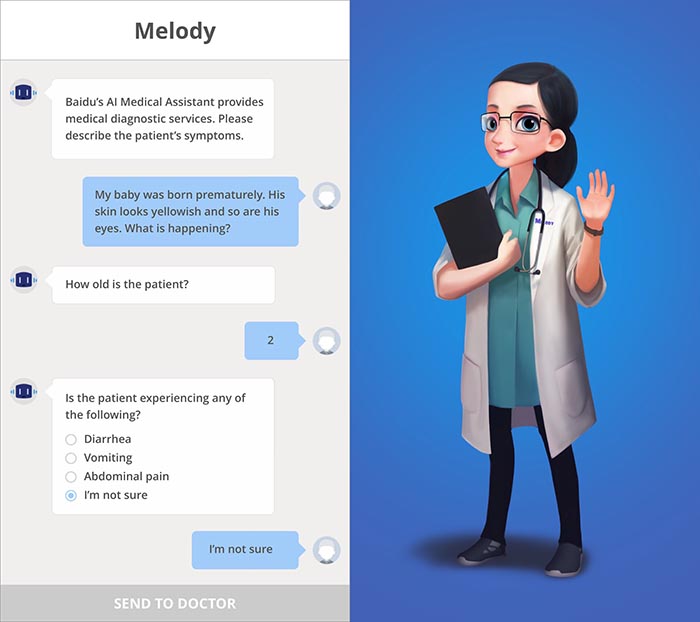
Melody is a virtual medical assistant inside of the Baidu Doctor app in China. The chatbot helps patients articulate their symptoms before seeing a physician.
One common problem doctor’s have with patients is that they often aren’t clear on their own symptoms before booking appointments or seeking medical treatment. Melody the Baidu bot seeks to solve this problem by chatting with patients in an interactive way and helping them articulate their symptoms at the necessary level of detail for physicians.
Maakindustrie en servitisatie: een sterke combinatie
Interessant artikel over servitisatie, nieuwe verantwoordelijkheden voor medewerkers en het belang van een kwalitatieve uitrol in de organisatie.
In dit artikel wordt heel sterk de nadruk gelegd op het belang van een transformatie naar een organisatie waar ALLE medewerkers betrokken en verantwoordelijk zijn voor het 'servicen' van de klanten.
https://www.agoria.be/nl/Maakindustrie-en-servitisatie-een-sterke-combinatie?

The 6 ways to grow a company
Interesting article about growth strategies - innovation - allocation of budget and resources
by Gino Chirio, in HBR.org, June 14, 2018

In opbouw! Under construction!
In (permanente) opbouw!
Under (permanent) construction!
Om commerciële succesvol te blijven, moeten bedrijven in staat zijn om in een steeds hoger tempo nieuwe produkten en diensten op zodanige wijze te ontwikkelen en te commercialiseren, dat ze onmiddellijk perfecte oplossingen zijn voor actuele klantproblemen.
We spreken over het permanent creëren van unieke waardevoorstellen.
De running lean methode van Ash Maurya laat toe om niet alleen snel en gefocused op de belangrijkste risico's te werken in het ontwikkelingsproces van nieuwe produkten en diensten, maar daarbij ook permanent met early adopters te interageren. Dit laatste maakt het mogelijk om te leren en onmiddellijk bij te sturen.
So far so good... Vaak wordt het vergeten maar ook de commercialisering van nieuwe produkten en diensten moet eveneens nieuw ontwikkeld worden. Wanneer marketing en verkoop na (of al tijdens) de ontwikkelingsfase grondig nadenken over een nieuwe commerciële aanpak voor het lanceren van deze producten en diensten, en deze nieuwe verkoopprocessen ook grondig testen, stijgt de kans op een succesvolle lancering aanzienlijk.
Bij deze aanpak van idee tot commercialisering, is het belangrijk om veel aandacht te besteden aan het samenstellen van het innovatie team, het proces uit te tekenen, en te zorgen voor de juiste begeleiding.
In order to continue being commercial successful, companies must be able to develop and commercialize new products and services in an ever-increasing pace and in such a way that they are immediately perfect solutions to current customer issues.
We prefer to talk about permanently creating unique value propositions.
Ash Maurya's running lean method allows not only to work quickly and focused on the major risks in the development process of new products and services, but also to interact with early adopters permanently. This latter makes it possible to learn and to adapt immediately.
So far so good ... Often forgotten, but also the commercialization of new products and services must also be developed. When marketing and sales after (or already during) the development phase thoroughly reflect on a new commercial approach for launching these products and services, and also thoroughly testing these new sales processes, the likelihood of successful launches increases significantly.
In this approach from idea to commercialization, it is important to devote a lot of attention to the creation of the innovation team, to drawing the process, and to ensure proper guidance.
The middleman and blockchain
What to do with the 'middleman', between seller and buyer?
'#Blockchain is changing the way we do business – what it means for the middleman. ' (Boston consulting group, oct. 12 2017)
WRONG THINKING
WRONG THINKING
Think of the worst idea possible and work back to find new ways of solving old problems
'There are many creative tools a designer uses to think differently, but none is more counter-intuitive than “wrong thinking,” also called reverse thinking. Wrong thinking is when you intentionally think of the worst idea possible — the exact opposite of the accepted or logical solution, ideas that can get you laughed at or even fired — and work back from those to find new ways of solving old problems.' ('Idea, Start by Imagining the Worst Idea Possible by
Ayse Birsel, Aug 16 2017, Harvard business review)
https://hbr.org/2017/08/to-come-up-with-a-good-idea-start-by-imagining-the-worst-idea-possible
Strategy and execution seems to be a difficult combination
Only 8% of leaders are very effective at both strategy and execution
https://twitter.com/robertllewellyn/status/920681241749393408
Bright Spots for Growth: Innovate, Engage, Grow

GROW IS ABOUT INNOVATION, BRIGHT SPOTS AND ENGAGING GREAT PEOPLE!
Ambitious firms build and grow based on Bright Spots.
Their best people are therefore given the opportunity to participate in the Bright Spots Program.
Something for your company?
Don't miss this chance.
Call us. +32476524952
#commercialinnovation


They take partnership seriously!
They take partnership seriously! Innovative marketing and real partnerships, keys to success.

How a mix of innovative marketing and real partnerships ensure success in a traditional industry.
Associated weavers, is one of the biggest producers of tufted broadloom carpet in Europe. It was a company in need in 2008 in a classic, declining market.
A blend of innovative marketing and the real ambition to work in partnership with selected customers, has made this company great again. They take partnership seriously!
To make their customers better (make them sell better), they support them with all AW - expertise that they have. What they do, they do to make the customer better. They not only develop top products and brands, but they also create marketing and sales tools, and they provide training and coaching for the sales force of their customers. They convert customer intimacy to reality. But... they are selective. They choose for customers who are willing to grow together.
However, Associated Weavers (AW) is also well aware that the development and production of high quality carpet products is still their core business. Therefore, they have a strong R & D (product development) department. The development of top products that perfectly meets the market demand stays a priority.
Watch the Associated Weavers Cycle of Growth video on the Thrust-youtube channel:
Who said it would be easy?
Who said it would be easy? Innovation is more than hard work.

Innovation is the future of any organization. It is, however, more than hard work. Let's be realistic ...
Let's be realistic ...Less than 30% of change programs are successful. Factors responsible for failure of change (including innovation) initiatives are for instance management behavior which is not supportive, the high degree of employee resistance, and the lack of required resources.
How can we improve our success rate?
When we are aware of the following elements from the start of our innovation initiatives, we might have a chance to be among the 30% successful change programs:
- Innovation needs to be done when it goes well with the business: when it goes badly with the business, it is really too late to have time, money, people and other resources available for innovation initiatives. Especially when we know that in any innovation project, there is a chance that this initiative will not reach the finish line. On the other hand, in a business where it is going well, there is not enough pressure to innovate drastically. It ripples further based on the current successes and it makes little sense to innovate and change thoroughly. Therefore ... put always pressure on innovation projects by reducing available time and resources.
- Each innovation group contains intrinsically more or less innovation potential: 'super designers' no longer exist. Innovation happens in team. The team potential is determined by the presence of participants with different mental models (how they look differently at the world) and different backgrounds (academic , jobs, community), the willingness to work in a team and to learn collectively (also under pressure and when it goes badly). Preferably, the team may not only consists of creative people. Even more conservative people are needed in the team. Finally, they should be able to decide autonomously, how they will work together (no pre-assigned processes).
- Welcome to the war zone: it is known that many successful changes and innovations have come only after a lot of struggle and after reaching the bottom. So if you realize that on the road to success, you will have to convince management and employees more than once, you will have to deal with conflicts in the innovation team which will need to be resolved, innovation and change will best be done with limited resources and by working under time constraints, that there will be a chance that even the current business model will be thoroughly shaken, and that indeed the company may have to opt for a comprehensive transformation rather than a small change, ...you're on the winning side. It is perhaps best compared with the mentality, entrepreneurship and the growing pains of a start up or scale up.
![[Service design] - What makes a customer really happy?](https://images.squarespace-cdn.com/content/v1/56f53cf6b09f955f052e3847/1588082493343-TO1H22CSB6ODQUUVTLN6/Canva+-+Closeup+Photo+of+Gray+and+Black+Custom+Frame.jpg)
[Service design] - What makes a customer really happy?
What makes a customer really happy?
Nowadays, [value propositions], [segmentation] and [market approaches] based on [customer / buyer journeys and personae], are an integral part of modern commercial policy. But is this enough to make a [competitive difference]?
Read more

Listen to customers
An easy but very powerful key question in commercial innovation. What you really want to know about your (potential)customers…
What makes a customer really happy?
![[Commercial innovation] Happy Customers](https://images.squarespace-cdn.com/content/v1/56f53cf6b09f955f052e3847/1588073257358-OWJDUX6VWUIWGMWPAFUU/%5Bcommercial+innovation%5D+Happy+customers.jpg)
[Commercial innovation] Happy Customers

Nowadays, value propositions, segmentation and market approaches based on customer / buyer journeys and personae, are an integral part of modern commercial policy. But is this enough to make a competitive difference?
Sometimes companies forget to focus on the main DRIVER and main reason for commercial innovation initiatives. ‘What makes a customer really happy?’ is the underlying core question to gain in-depth insights into the customer's needs and wishes, their motives and emotional involvement, from the development of new services, from their commercialization, and from the daily realization of these services.
In summary, we can say that it is the personal context related to the the underlying question of what makes a customer really happy, that is more determining than only the technical writing of personae, journeys and value propositions.
If we are able to develop an 'iterative approach' to be in permanent contact with customers and prospects, to understand their real (emotional) challenges, to relate their personal context to our solutions and innovations, to transfer it optimally to the daily operational activities, then we create added value. ‘What makes the customer really happy?”, is the core question that every employee should ask him-/herself permanently.
Developing new services, products or even new customer approaches, without a clear answer to this key core question doesn't solve anything. In many companies, marketing teams, design teams and R & D teams are working on the (commercial) innovations of the future, but at a great distance from the end user / customer.
Therefore these 5 tips

Learn from ‘them’, co-create and test together
Learn about 'them': learn and experience the customer in real life and their personal context, and not only from desk research. Test and co-create with customers at all stages of innovation and even during the roll out. Learn about the actual impact of competition on your customers and prospects.
Involve marketing and sales from the start: they know the customers in a different way and have access to them. By involving them actively from the start, it will become also easier for them to sell or market these new services and products afterwards. They will better understand what the added value for the customer will be.

Involve marketing and sales from the beginning

In-depth interviews
Create a system of Learning Cycles: make use of short learning cycles with internal and external customers as important test. Adjust quickly in the learning process after interaction with and feedback of the customers. Build, measure, learn, build further!

Quality of ideas * execution = value
Understand happiness: learn how to work with in-depth interviews, panels or focus groups in all phases of the development / commercial innovation. Go to the bottom to understand in detail what 'Happy' really means and how this can be reached during the customer journey towards happiness.

Learning cycles
Don't forget
'The Quality of ideas * Execution = Value' The world’s simplest formula… explains why you can’t forget commercialization. Develop and test therefore The Most Valuable Commercial Approach.

Innovative solutions and the search for Fit
Innovative solutions and the search for Fit
Innovative solutions and the corresponding value propositions are only relevant if they fit at three levels. Read this article

Innovative solutions and the corresponding value propositions are only relevant if they fit at three levels
![[Innovation] The identified challenge or problem for your company and the customer.](https://images.squarespace-cdn.com/content/v1/56f53cf6b09f955f052e3847/1587980214310-H0KE0IV7QMY6CIEU991J/Canva+-+Photo+of+Man+Holding+Black+Rope.jpg)
[Innovation] The identified challenge or problem for your company and the customer.
In the first place, an innovative solution and its corresponding value proposition have to address the identified challenge or problem for your company and the customer.
All great ideas are of little significance if they are not appropriate solutions for the identified problem(s). Therefore it is very important to identify first all real challenges or problems, to cluster and prioritize them (assigning weight) for example on the basis of the impact that they (can) have for the business. A facilitator can help you with the process of identification, clustering and prioritizing. It is important to be able to start from the underlying real problem or challenge, which often manifests itself not immediately and clearly. Every innovative idea must first be checked against the problem to determine whether it can be a suitable solution to this fundamental problem.
Secondly, each solution (product and/or service) must be appreciated and validated by the customer.
It must be examined in the market and among customers if the solution is really valuable to the customer and whether there is a positive reaction of the customer. What are the chances that the solution really get a grip on the market and target audience?
![[Innovation] Validation by the customer](https://images.squarespace-cdn.com/content/v1/56f53cf6b09f955f052e3847/1587980878734-9WOOGU0H8TH65HBZ8MTJ/Canva+-+Man+Touching+Smiling+Face.jpg)
[Innovation] Validation by the customer
![[Innovation] Ingredients of a business model](https://images.squarespace-cdn.com/content/v1/56f53cf6b09f955f052e3847/1587981141072-CZV4S3QP4PC43NAE2B92/%5BThrust%5D+Ingredients+of+a+business+model.jpg)
[Innovation] Ingredients of a business model
Finally, there should be a search for the way the innovative solution (product / service) fits into the business model.
In other words, it should be considered whether the innovative solution actually can be set up, can be organized and embedded in to a profitable and scalable business model.
About the author
![[Thrust] - Consultant Chris Delvaux.jpg](https://images.squarespace-cdn.com/content/v1/56f53cf6b09f955f052e3847/1587979667059-5022OUI8EP9BXIUQMV2U/%5BThrust%5D+-+Consultant+Chris+Delvaux.jpg)
Chris Delvaux has over 15 experience as a senior consultant. He is specialized in go-to-market optimization, business model innovation and service design. He facilitates and coaches teams in commercial transformation projects from the analysis to the result. He works strategically AND pragmatically. He has worked for clients such as Baxter, Nashuatec (Ricoh), DVV Insurance, Associated Weavers, Stihl Benelux

Go-to-market challenges and guidelines for optimization
Go-to-market challenges and guidelines for optimization
How to develop commercial potential in a customer-driven and omni-channel economy?
![[Thrust] Go-to-market.jpg](https://images.squarespace-cdn.com/content/v1/56f53cf6b09f955f052e3847/1587977890161-OOH1WCBTG7M69APAIB2P/%5BThrust%5D+Go-to-market.jpg)
Go-to-Market - solutions
What are the best solutions for the Go-to-Market challenges?
Improving the Go-to-Market approach needs to be done in three phases. A thorough analysis of the entire commercial ecosystem is the basis for the next two steps: "without a diagnosis, no prescription”. In a second phase will be examined how the commercial strategy can be enhanced and additional commercial value can be created. In phase three, the focus is on how the organization will be prepared for the future.
![[Chris Delvaux] Go-to-market whitepaper](https://images.squarespace-cdn.com/content/v1/56f53cf6b09f955f052e3847/1587977138564-RME337JSHV15N4CPSH8N/%5BChris+Delvaux%5D+Go-to-market+whitepaper)
Go-to-market challenges
A maximum development of commercial potential in a customer-driven and omni-channel economy.
Commercial potential remains often untapped. A lack of effectiveness in sales and marketing approach is one of the main causes of falling sales figures and declining growth power.
The first major challenge is the discovery and development of intrinsically present, commercial potential in sales and marketing approaches. The second major challenge is the elimination of significant differences in methods and results between top executives and top managers, and the rest of the organization. The need for a better alignment of activities and responsibilities between the marketing, sales and other departments, is the third major challenge.

Go-to-market-solutions /additional commercial value
About the author
Chris Delvaux has over 15 experience as a senior consultant. He is specialized in go-to-market optimization, business model innovation and service design. He facilitates and coaches teams in commercial transformation projects from the analysis to the result. He works strategically AND pragmatically. He has worked for clients such as Baxter, Nashuatec (Ricoh), DVV Insurance, Associated Weavers, Stihl Benelux
![[Business Model Innovation] Revolutionise your business](https://images.squarespace-cdn.com/content/v1/56f53cf6b09f955f052e3847/1587975409470-8SRGCJ7P4HHIRT6GW5CJ/image-asset.jpeg)
[Business Model Innovation] Revolutionise your business
Revolutionise your business. Get more value out of your business by using the Business Model Navigator to innovate your business. It builds on the central idea that successful business models can be constructed through creative imitation and recombination. -Oliver Gassmann
Get more value out of your business
Business model innovation has additional innovation potential compared to process, product or technology innovation. Many of the big successes like Amazon, Apple, Holcim, Ebay, Ryanair or Ikea, are rather based on innovative business models than on new products. Through business model innovation, you can get more value out of your business. The number of business model innovations has increased significantly over the last 20 years (source: ITEM-HSG). More than 50% of executives believes that their business model will undergo fundamental changes in the next ten years (source: McKinsey, 2011)
Thrust helps to innovate through the Business Model Navigator TM
The Business Model Navigator (BMI-Lab / St. Gallen) is an action-oriented methodology that permits any company to break with its dominant industry logic and innovate its business model. It builds on the central idea that successful business models can be constructed through creative imitation and recombination. (Source: Oliver Gassmann, Karolin Frankenberger and Michaela Csik 2014). 90% of all new business models aren't actually new. They are based on 55 existing patterns. (source: Oliver Gassmann, 2014). These 55 patterns can boost the innovation of your business. It will help you in a creative way to figure out where your business fits in, and which creative imitation and recombination is the most valuable for your business.
Thrust helps with innovation through the Business Model Navigator. We help our clients to analyze the current business model and ecosystem, in facilitating innovation workshops to develop new ideas through the 55 patterns applied to its own business, and/or in the phase of testing and implementation (change management). Or we we guide and facilitate the entire innovation process if desired.

If you are interested to see how THRUST can help you with this approach to innovate successfully your business, contact THRUST

How does service design work?
Service design is an iterative process in four steps.
The basic service design approach consists of exploration, creation, reflection, and implementation.
Service design
Is an iterative process in four steps
Fundamentally and in reality, it is not a linear process and certainly not a standard process. But as service design is a complex process, we work in four different steps to structure the approach. The basic service design approach consists of exploration, creation, reflection, and implementation.
It is also an iterative process. That means that it must be able to return to the previous step regularly, or even start all over again from scratch. It is necessary to be critical and courageous to step back, start all over again, or even stop the design process. The benefit of structuring the design process is that it enables a greater degree of reflection upon all activities, outcomes and influences of the design team.
Keep always the entire process in mind (from a helicopter view), especially when you put a lot of energy in the improvement of a concrete activity with lots of details. E.g. if you are redesigning employee interactions between sales and marketing staff, it is also important to consider the organizational level and structure as a whole. In other words, it is not a success to work on interactions between two people respectively from the marketing and sales department, as these departments themselves need to improve cooperation and interaction.
Four steps
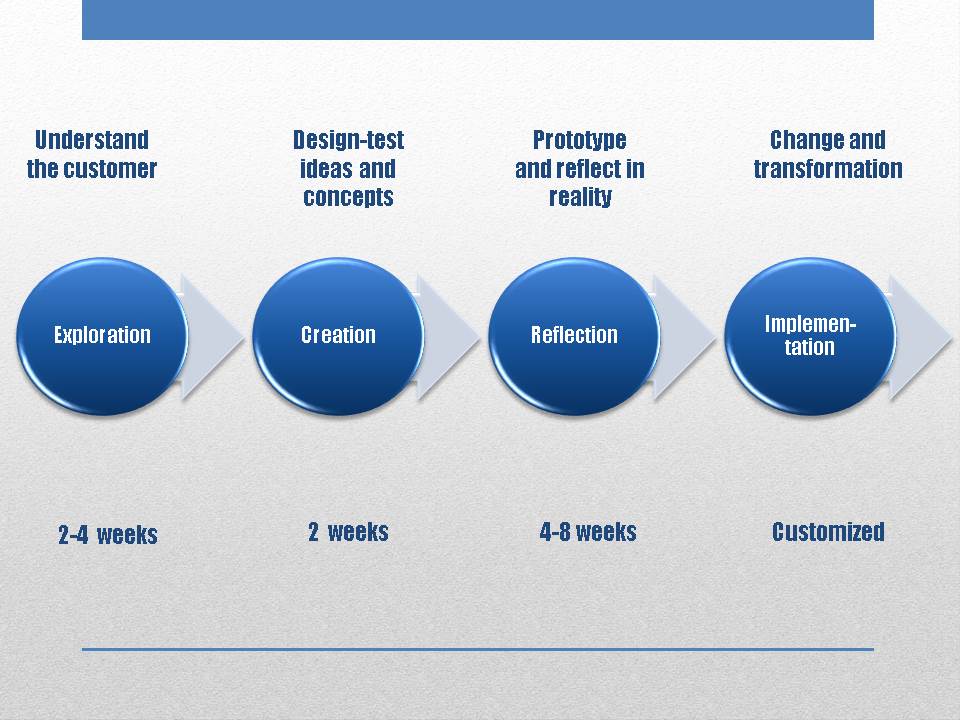
The starting point in the exploration phase is the customer. Whether it is for current customers or potential customers, it is essential to properly understand the situations, interactions, customer journeys, attitudes and expectations of the (potential) customers. Ways of researching are for example by going on an exploratory manner in conversation with the customer, customer panels, or by observing customers. The ways in which this information is obtained, and the attention to details are keys to future success.
During the creation stage, it is all about designing, testing and retesting ideas and concepts. It is a co-creative ideation process, where it is important to involve all main stakeholders and to work with interdisciplinary teams that include customers, managers, employees, engineers, designers, sales, marketing and other stakeholders. In this stage it is important to stimulate co-creativity as much as possible, and to work user-centred. Using sticky notes for visualizing the process is another key to success. The creation stage is closely related to the reflection stage. Practically, there are a variety of methods and tools which can be used in the creation stage. E.g. designing hypothetical stories, drawing storyboards (sequence of events), or even using Lego materials to express a service environment ,can all be interesting to use during the creation stage.
As already told, the reflection stage is closely related to the creation stage. However, in the reflection stage it is important to build or prototype service concepts in reality or circumstances close to reality. But the main challenge at this stage in the process is dealing with the intangibility of services. Therefore it will be very helpful to consider carefully how to provide customers with a good mental image about the future service. That is the main goal at this stage. In order to obtain emotional engagement for the new service, the way in which this is proposed will be of great importance. Methods which are useful for this purpose and help visualize the new service are again methods like storyboards, a comic strip, video, photos, simulations and co-creation. Feedback needs to be collected in a thorough way through interviews, observation, surveys.
A design process is not successful, if the new service isn’t implemented properly. The implementation stage may be considered as a real change or transformation stage, with lots of obstacles and resistances. Therefore it is very important to work with ‘ambassadors’, who were already involved and contributed already in earlier stages. If they have a clear vision of the concept, and if they were already involved in developing and testing the prototype of the new service in interaction with real customers, there is a high probability of a successful implementation. Successful methods we use in this stage are storytelling, service blueprints, testing with real customers or role plays, business model canvas and action plans.
In every stage we have several workshops with main stakeholders, but with different goals, perspectives and approaches.
If you want more information about service design thinking and to evaluate if this approach could be interesting for your organization, contact THRUST
For more information about our services, click here
Business model innovation
Commercial innovation by developing a new business model
Commercial innovation by developing a new business model, is one of the possibilities to create added customer value.
What is the best way to do it?
You can find some interesting tips about developing a new business model in the video from the University of St Gallen, Switzerland. (By Prof. Dr. Oliver Gassman). The video is also about typical myths in innovation.
Click here to read more about our services.
If you want more information about commercial innovation by developing a new business model, CONTACT THRUST
For more information on business model innovation, go to www.bmi-lab.ch

The new rules of innovation
Innovation is taking risks
Interesting and inspiring TEDxBerkeley -talk about innovation.
Innovation is taking risks
Interesting and inspiring TEDxBerkeley -talk about innovation. Uploaded on Feb 25, 2012
From Carl Bass , President and CEO of autodesk, Inc. Autodesk is the leader in 3D design, engineering and entertainment software. Formerly he was Autodesk's chief operating officer, responsible for worldwide sales, marketing, and product development. Earlier roles included CTO and EVP of product development.
His key message is that innovation is happening at an unprecedented pace and will continue to accelerate because of 5 trends:
1. The age of Access and Experience
2. Business Un-Usual
3. Digital fabrication
4. Rise of information
5. Infinte Computing
Watch now
For more information on commercial innovation methodologies and approaches click here, or contact THRUST
What is commercial innovation?
Innovation or invention?
Innovation is often mixed with invention. Invention is typically linked to product or technology development (R&D). Innovation however, includes all non-product (or technology) innovation.
What is commercial innovation?
The core of innovation is the commercial use of an invention. Commercial innovation includes all forms of innovation aimed at increasing customer value. Especially, it is about new business or market entry models, whole new service offers, better aligned and redesigned processes, improved customer experiences, transformed customer relationships, new distribution channels, extra customer tools and apps. It could also be about new visions on business potential, innovative value propositions, a different perspective on market segmentation and all other non-product innovations which provide more customer value.
The internet is one of the best examples of commercial innovation. In less than a decade, the internet went from being connected networks used by universities and the military to the very powerful commercial engine it is today. (Greenstein Shane, How the internet became commercial: innovation, privatization, and the Birth of a new network, Princeton University Press, 2015)
Increasing customer value?
Increasing customer value may be realized by either increasing the benefits as perceived by target customers or by reducing their experienced sacrifices.
Do you want more information? Contact us
Click here to read more about our services

Welcome to our new website!
The importance of commercial innovation
Hello world, this blog is about commercial innovation, customer relationships and service design thinking, but also about personal and team coaching.
Digitization gives new possibilities but is also responsible for the current disruptive economy. In this disruptive economy, new powerhouses emerge as Google, Apple, Facebook and others. They ensure that even very old, large companies shake to their foundations and begin to question their existence. For example, banks and insurance companies, but also the automotive industry are all threatened by new entrants who use often IT and digital solutions and have often a fresh look at traditional challenges. Why doesn't drive a car independently? Why does a surgeon operate still manually? Why do we still use physical (paper) money to pay? Therefore, it is important that any organization continues to innovate. Certainly 'commercial innovation' has become even more important. It is not just about product innovation, but also about everything we do in order to service the customer better and the added customer value we create in this way. Read more about it next time.
Personal coaching to activate individual potential
In this blog and website, however, we will also write about the importance of human interaction, personal coaching and building teams. Especially in times of rapid change, the quality of human contact, personal performance and team functioning is more important than ever. Also striving for a better balance and to more happiness, both at work and in private life, deserve more attention. The demand for personal and team coaching is therefore rising.
Next time we continue with commercial innovation and different approaches.
For more information about our services, click here, or contact THRUST
See you again!